
REVIEW · NEW ZEALAND
Auckland Dolphin and Whale Watching Eco-Safari Cruise
Auckland’s best wildlife outing is less about ticking off one whale and more about spending half a day in the Hauraki Gulf Marine Park, where dolphins, seabirds, islands, and changing sea views share the stage. The custom-built catamaran gives you a good platform for watching the water, with indoor seating, outdoor viewing areas, toilets, and snacks for sale.
I like the connection to marine research and conservation, which gives the commentary a real purpose. I also like the crew’s effort to find wildlife without crowding or chasing it, plus the free return trip offered when no marine mammals are seen. The catch is simple: wild animals set the schedule, and a full boat can feel tight when everyone moves to one side.
Key points to know before you book
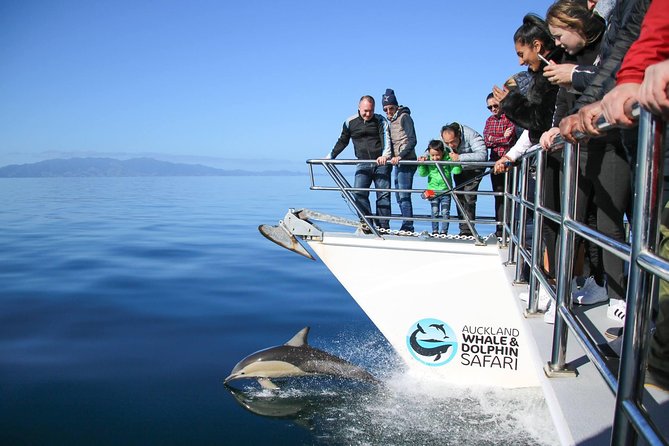
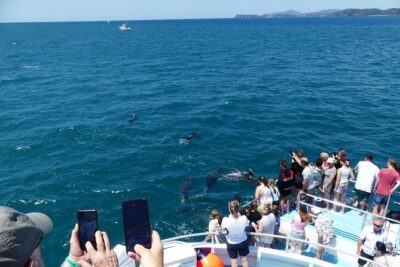
- Dolphins are the most reliable highlight: Pods often swim beside the catamaran, sometimes with young dolphins and repeated appearances lasting close to 30 minutes.
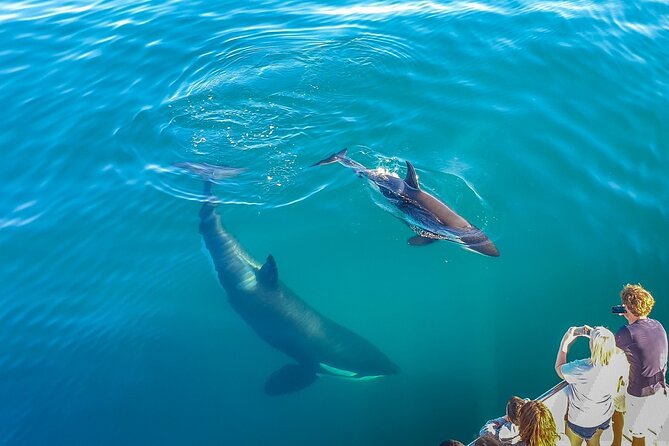
- Whales are possible, not promised: Bryde’s whales and several other whale types use the gulf, but some departures see none.
- The boat carries up to 99 people: It is stable and well set up for viewing, but outdoor positions become competitive when wildlife appears.
- The route is scenic even on a quiet wildlife day: You pass the Harbour Bridge, Rangitoto, Motuihe, Motutapu, Tiritiri Matangi, and North Head.
- Bring serious sun and wind protection: Wear warm layers, weatherproof clothing, sunscreen, sunglasses, a chin-strap hat, and flat-soled shoes.
- The $135.91 price is reasonable for the length: You receive a 4.5-hour cruise, specialist commentary, and a conservation contribution, but food and transport to the pier cost extra.
A 4.5-hour safari from downtown Auckland
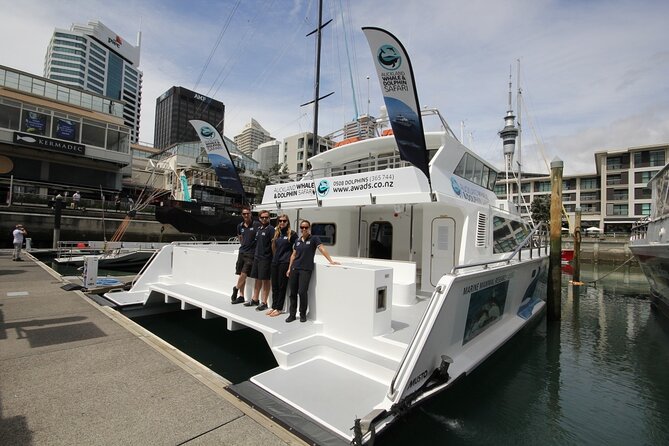
The Auckland Dolphin and Whale Watching Eco-Safari leaves from Eastern Viaduct beside the New Zealand Maritime Museum. That is a handy starting point if you are staying in central Auckland, and it is close to public transport. You check in at the pier, not at a hotel, so allow time to reach Viaduct Harbour and be ready at least 15 minutes before departure.
The check-in cutoff matters. Late arrivals risk losing their allocated seats, which is especially important if you are visiting Auckland on a tight schedule or arriving from another activity. Hotel pickup and drop-off are not included, so plan your own route to the waterfront.
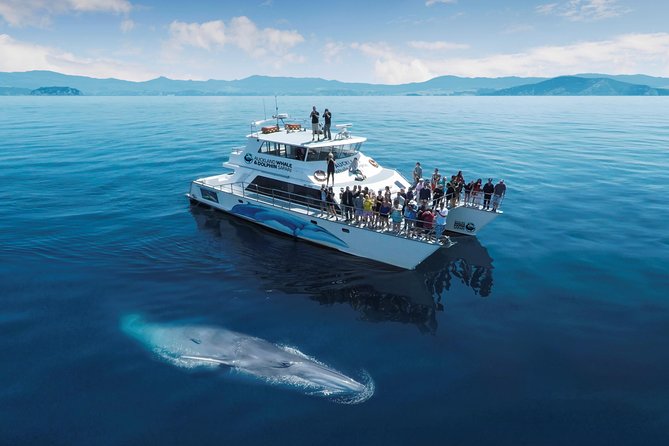
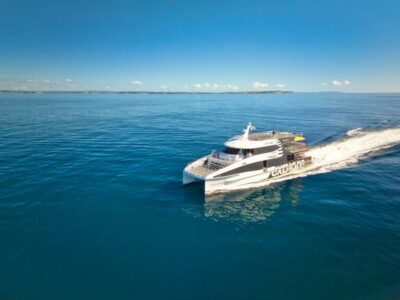
The boat is a 65-foot, 20-meter catamaran built for viewing. A catamaran generally gives you a stable ride, and several comments describe the vessel as comfortable and steady. Still, this is an open-water cruise, not a calm harbour ferry. Wind can make the ride chilly, and some departures have been quite choppy.
You can watch from outside or retreat indoors when the weather turns. There is a small shop with snacks and drinks, plus toilets onboard, but meals are not included. I would eat before departure and treat the onboard shop as a useful backup rather than a lunch stop.
More Whale and Dolphin Watching Tours in New Zealand:
- Auckland: Whale and Dolphin Watching Half-Day Eco Cruise
★ 4.5 · 1,072 reviews - Auckland: Tikapa Moana Whales, Dolphins and Islands Cruise
★ 3.9 · 292 reviews - Auckland: Tikapa Moana Dolphin, Whale and Island Cruise
★ 4.0 · 17 reviews
Viaduct Harbour, the Harbour Bridge, and the first views
The opening stretch gives you a pleasant introduction to Auckland from the water. Viaduct Harbour places the city skyline behind you as the boat heads toward the Auckland Harbour Bridge. This part of the trip helps you get your bearings before the boat reaches more open water.
The Harbour Bridge is one of Auckland’s clearest visual markers, and viewing it from the water gives you a different angle from the usual city lookout. Keep your camera ready, but do not spend the whole first half-hour staring at your screen. The city gradually gives way to islands and open sea.
The route then moves through Waitemata Harbour toward Rangitoto Island. Rangitoto’s volcanic form is hard to miss, and it provides a striking backdrop as the boat heads into the gulf. You are not getting an island walking tour here. The point is the passing view, so think of this section as scenic context for the wildlife search.
Rangitoto and the Hauraki Gulf Marine Park
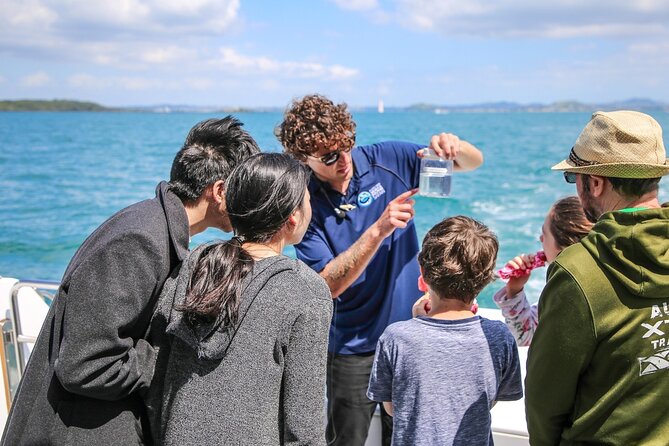
Once the catamaran reaches the Hauraki Gulf Marine Park, the focus shifts from Auckland’s buildings to the water. The park includes five marine preserves and supports about 23 marine species, making it more than a pretty setting for a boat ride. The guides explain how the area functions as habitat and why the crew tracks particular whales and dolphins.
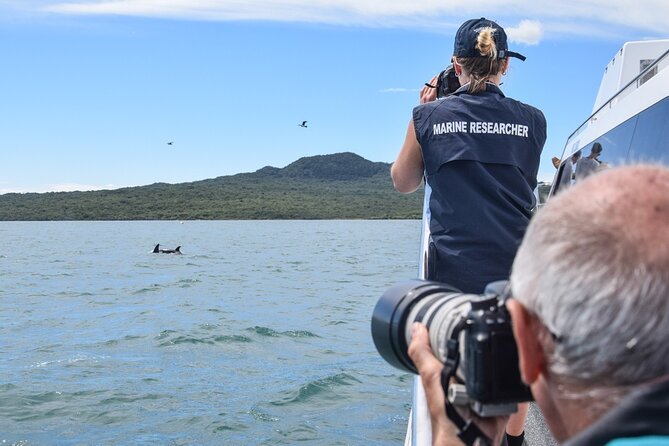
This is where the research side of the outing becomes valuable. Marine research scientists join the onboard team, share current work, and help explain what the crew is looking for. You are not simply handed a list of animal names. You get some context about how marine mammals use the gulf and why sightings vary from day to day.
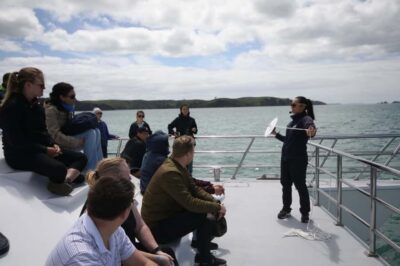
The commentary can be excellent, though volume has not always been consistent. If you are sitting outside at the back, you may find some announcements harder to hear when the wind picks up. Move closer to the speaker when possible, and ask staff to repeat anything important. The information is worth making the effort to catch.
The crew also points out seabirds. Australasian gannets, petrels, shearwaters, and white-fronted terns may appear over the water, either gliding low or plunging after fish. Blue penguins and seals are possible too. These smaller sightings matter because they give the crew more to show you when whales are out of range.
Motuihe, Motutapu, and Tiritiri Matangi
The island section gives the cruise its sense of place. Motuihe and Motutapu sit among the gulf’s many islands, and their shores help frame the search area. You will not spend time ashore, but the changing views make the long ride feel like a tour of Auckland’s marine backyard rather than a straight trip out and back.
Tiritiri Matangi is also part of the route. The island is associated here with the wider wildlife setting, not a landing or guided walk. From the boat, you get another reminder that Auckland’s waters connect islands, seabirds, marine mammals, and conservation work in one large protected area.
This is also the section where patience pays off. A pod may appear suddenly, then vanish just as quickly. The captain and crew adjust the route when reports or sightings suggest animals are nearby, but they cannot control where a whale surfaces or how long dolphins stay.
The best dolphin encounters can be surprisingly active. Dolphins have been seen swimming and playing at the front of the boat, sometimes in large pods and sometimes with young animals. A strong sighting may last only a few minutes, or it may continue for nearly half an hour with repeated appearances.
More Safaris in New Zealand:
- Los Cristianos Respectful No-Chase Whale and Dolphin Safari
★ 4.6 · 12,782 reviews - Lisbon: Dolphin Watching with a Marine Biologist – Ocean Safari
★ 5.0 · 812 reviews - Wild Dolphin Watching and Snorkel Safari Off West Coast of Oahu
★ 5.0 · 795 reviews - Fazana: dolphin safari and sightseeing in Brijuni at sunset
★ 4.5 · 763 reviews
What you might actually see
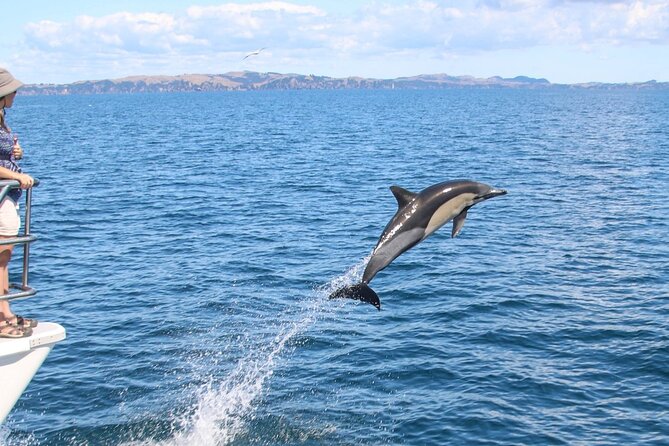
Dolphins are the strongest reason to book this trip. Bottlenose dolphins are frequently spotted in the gulf, and the experience can be excellent when a pod chooses to travel alongside the catamaran. You may see them from the front deck, where their movement is especially easy to follow, but that area can become crowded quickly.
Whales are less predictable. Bryde’s whales are native to New Zealand waters and are among the species the crew tracks. Up to six types of whales may be encountered in the wider area, but that does not mean you will see six types, or even one, during your four and a half hours.
Some departures produce a memorable mix of whales and dolphins, while others produce dolphins, penguins, seals, and birds but no whale. There have also been outings with only brief dolphin sightings. That range is normal for a wildlife cruise, and you should book with the right expectation: the crew searches hard, but it does not manufacture sightings.
The return-trip policy softens the risk. If you see no marine mammals at all, you can take the cruise again on another day without paying another fare. That is a useful promise for people staying in Auckland for several days. It is less useful if you are visiting from overseas and leave town immediately, so factor your own schedule into the value.
North Head and the ride back to Auckland
North Head Historic Reserve appears near the end of the route, adding another Auckland landmark before the catamaran returns to Viaduct Harbour. The reserve sits at the entrance to the harbour, so its position helps you understand the route back toward the city.
The return leg is not filler. After several hours outside, you can review photos, warm up indoors, or keep watching for one last seal or seabird. The guide may continue talking about the gulf and the research program, though commentary quality can depend on where you are sitting and how loud the wind is.
The boat is due back at the original meeting point, so you do not need to arrange a separate return transfer. Allow a little breathing room before your next fixed booking. The published duration is approximately 4.5 hours, and wildlife searches can occasionally run slightly long when the crew is still trying to locate animals.
How crowded is the catamaran?
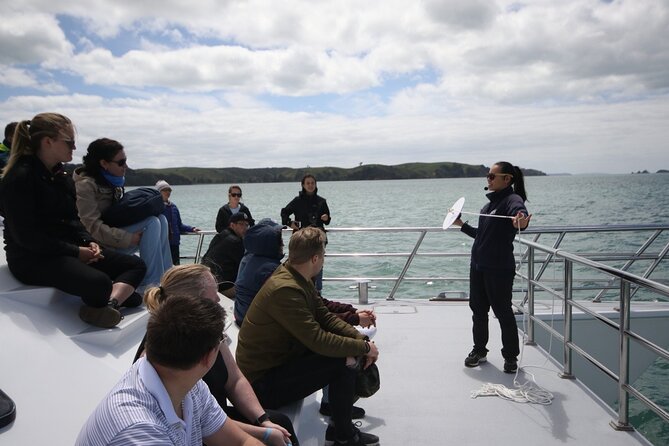
The advertised maximum is 99 people. That is a sizeable group for a wildlife boat, and the experience can feel crowded during school holidays or other busy periods. Most of the time, the catamaran offers enough room to sit and watch, but the situation changes when dolphins appear.
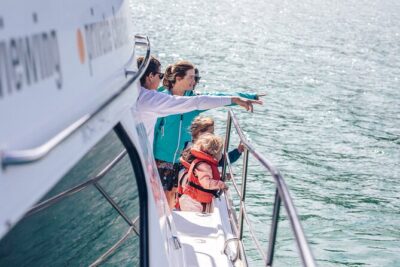
If you leave your seat to collect something or move to another viewing spot, someone else may take the space. When rain pushes everyone under cover, seating becomes more limited. At the rail, people can gather several rows deep, particularly when a pod swims near the boat.
The crew asks people to rotate and share views, which is fair and necessary. You can improve your own day by moving around before the action starts, keeping your gear compact, and remembering that no single photo is worth blocking the view for everyone behind you.
Families and first-time wildlife watchers should find the setup workable, but anyone wanting a quiet, private boat ride should choose a smaller charter instead. This is a shared safari with a research and education focus.
Weather, comfort, and what to pack
Auckland weather can shift quickly, and the gulf is more exposed than the city waterfront suggests. Wear several warm layers and bring weatherproof clothing. Even on a sunny day, wind across the water can make the boat feel cold.
Pack sunscreen, sunglasses, and a hat with a chin strap. A loose hat can easily blow away, and the glare off the sea is stronger than you may expect. Flat-soled shoes are recommended for moving around the boat safely.
A camera and binoculars are useful, though the animals may surface close enough for the naked eye. Keep your equipment secure and easy to carry. If you are prone to seasickness, the possibility of choppy conditions deserves serious thought, especially since the cruise lasts four and a half hours.
The catamaran has indoor space, toilets, and snacks for purchase, which make the long duration more manageable. Still, there is no substitute for wearing the right clothing. A waterproof jacket and warm mid-layer will do more for your comfort than any last-minute purchase onboard.
Is $135.91 good value?
At $135.91 per person, this is not a cheap harbour cruise. It is a half-day wildlife outing with a specialist crew, a custom-built catamaran, marine research commentary, and a direct contribution from every ticket to marine mammal conservation.
I think the price works if you value the full experience, not only the whale count. You are paying for time on the water, access to a large marine park, island scenery, onboard facilities, and a serious attempt to locate animals responsibly. A day with dolphins, whales, seabirds, and islands can feel like excellent value.
The calculation changes if you want a guaranteed whale sighting. No responsible operator can promise that, and some departures return without seeing whales or dolphins. The free return option helps, but only if you can use it.
Food, drinks, and transport to the pier are extra. Free cancellation is available up to 24 hours before departure. If poor weather cancels the trip, you can receive a different date or a full refund, and the same applies if the minimum number of participants is not met.
Who should book this Auckland cruise?
I would recommend it to anyone who enjoys wildlife, coastal scenery, and learning how marine research works. It suits families, couples, solo visitors, and anyone wanting a substantial half-day activity from central Auckland.
It is especially useful early in a longer Auckland stay, since a no-sighting day may be followed by another attempt. The cruise also works well for people who want more than a fast scenic ferry ride and appreciate the chance to support conservation.
I would think twice if you dislike open water, become uncomfortable in wind or chop, or need a guaranteed schedule. I would also avoid booking it as your only major activity on a short Auckland visit if you would be deeply disappointed by a whale-free day.
My booking verdict
Book this safari if you can accept wildlife on its own terms. The strongest parts are the frequent dolphin encounters, the island scenery, the research-led commentary, and the crew’s careful approach to marine animals.
Do not book it expecting a parade of whales. Pick a day when you have some flexibility, arrive early enough to check in without stress, and dress for wind rather than the temperature on Auckland’s streets. With those expectations, the $135.91 fare buys a substantial and worthwhile day on the gulf.
FAQ
Where does the Auckland Dolphin and Whale Watching Eco-Safari depart?
It departs from Eastern Viaduct at the New Zealand Maritime Museum in Auckland Central, near Viaduct Harbour.
How long does the cruise last?
The cruise lasts approximately 4.5 hours.
What animals might I see?
Possible sightings include whales, bottlenose dolphins, seals, blue penguins, Australasian gannets, petrels, shearwaters, and white-fronted terns.
Are whale and dolphin sightings guaranteed?
No. Wildlife sightings cannot be guaranteed. Dolphins and whales are often found in these waters, but some departures see few or no marine mammals.
What happens if no marine mammals are seen?
You can take the cruise again on another day at no extra charge if no marine mammals are seen during your trip.
Is food included?
No. Food and drinks are not included, but snacks and drinks are available to purchase onboard.
What should I wear and bring?
Wear warm layers and weatherproof clothing. Bring a sun hat with a chin strap, sunscreen, sunglasses, a camera, binoculars, and flat-soled shoes.
How early should I arrive?
Check-in closes 15 minutes before the stated departure time. Late passengers risk losing their allocated seats.
Just added around New Zealand
- Half Day Dolphin & Wildlife Cruise – Tauranga★ 4.5 · 103 reviews
- Dolphin & Wildlife Encounters★ 5.0 · 6 reviews
- Captain Cook and Dolphin Cruise★ 4.5 · 26 reviews
- Bird Watching and Dolphin Eco-Tour to Blumine Island★ 5.0 · 55 reviews
- The Original Full day Bay of Islands Cruise with Dolphins★ 5.0 · 13 reviews
- Kaikoura Swim with Dolphins Tour from Christchurch★ 4.5 · 27 reviews
- Kaikoura Whale and Dolphin Overnight Tour from Christchurch★ 4.0 · 9 reviews
- Akaroa with optional dolphin cruise (Small Group Tour)★ 5.0 · 3 reviews
New Zealand Dolphin Tours, compared.
Auckland: Whale and Dolphin Watching Half-Day Eco Cruise
Read our review →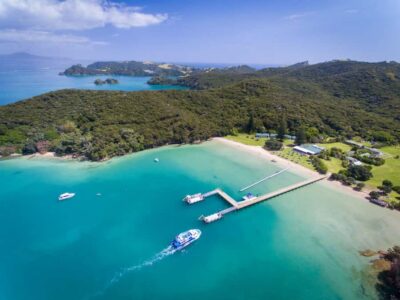
Paihia/Russell: Hole in the Rock, Dolphins & Island Cruise
Read our review →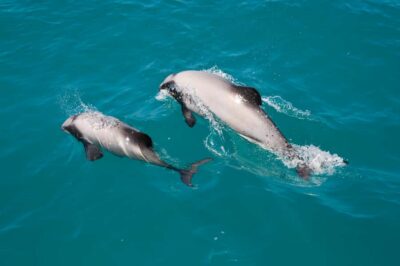
Auckland: Tikapa Moana Whales, Dolphins and Islands Cruise
Read our review →
Hole in the Rock Scenic Cruise including Dolphins and Island stop
Read our review →Browse the lists this tour appears in